| From Kulaura rail station its about one hour journey by microbus to Madhabkunda. The journey to Madhabkunda itself is exotic. On the way you can see the greenish beauty of tea garden, the hills and the zigzag road through the hills will increase the joy of your journey. In Madhabkunda you will see the great waterfall – falls of million tons of water form 200ft. height. Big bolder of stones and the black stones in giving a shape of care in Madhabkundu. There is a Parjatan Motel with a good restaurant for accommodation and fooding. |  [Madhabkundu Waterfall] |
Friday, June 18, 2010
Madhabkunda Waterfall
Madhabkunda waterfall is one of the most attractive tourist spots in Sylhet division. Lots of tourists and picnic parties come to Madhabkunda every day for their enjoyment. You can go to Madhabkunda either from Sylhet if you go by road or from Kulaura if you go by train.
There is also a district council Bunglow for night stay. Here you can enjoy adventurous feelings to stay in a jungle. All you need to have a prior booking for the bunglow from Moulvibazar Zilla Parishad office.

Jaflong


| |
Geography
Jaflong is approximately 60 km from Sylhet city and can be reached by local buses private car hire. There are some hotels available there to stay but quality is questionable.Attractions


- Collection of Rolling Stones
- Colorful Tribal (Khasia) Life See also: Khasi
- Khasia Rajbari (king’s palace)
- Dauki & Piyain Rivers
- Tea Garden
- Orange & Jackfruit Gardens
- Betel leaf & Areca nut Gardens.
- Dauki Bazar
Stone crushing
The land grabbers occupied government khas land and reserved forestland and extracted stone by cutting small hills polluting the environment of Jaflong. They also established crushing mills on the forestland without permission from government.Forestation program


Wednesday, June 16, 2010
Bara Sona Mosque
Bara Sona Mosque is the largest mosque in Gaur-Lakhnauti, the capital of Sultanate Bengal, and it marks the culmination of Sultanate architecture in Bengal. In contrast to its namesake, the chhota sona mosque, perhaps the most perfect edifice of the kind in ornamentation, the Bara Sona is sombre. Also, being more than double in size, it has a majesty unmatched by any other mosque of the country.
The builder of this mosque is still unknown. The inscription dated 932 AH (1526 AD), which Major Franklin discovered near the mosque at the beginning of the last century, is often believed to refer to as that of the mosque itself, ie, it was built by Sultan Nasiruddin nusrat shah. |  |
Bara Sona Mosque, Gaur-Lakhnauti |
But the recent discovery of another inscription in the debris just outside the mosque to its northwest corner appears to negate the view. The latter inscription (now preserved in the Maldah State Museum) speaks of a gateway constructed by Nusrat Shah in 930 AH (1523 AD). Since this inscription was found close to the site and very near the mosque, the ruins must be of the grand gateway of the mosque.
It precedes the date of Franklin's inscription by two to three years, which seems almost an impossibility, since the gate could not have been constructed prior to the building of the mosque itself, as the tradition is that the gateway of such an edifice is constructed after the completion of the main structure. Moreover, the style of the mosque is in mark contrast to that of the bagha mosque, built by Nusrat Shah, which is decorated in almost all its parts with terracotta ornaments in conformity with the Islamic concept of horror vacui. The Bara Sona is plain and almost devoid of ornamentation except perhaps the mihrabs, which being the most important part could be imagined to have been decorated profusely like all other mosques, but are now all not to be seen.
The Bara Sona has close resemblance in general appearance with the Chhota Sona built by a wali of Alauddin husain shah, perhaps during the early part of his reign. The similarity between the two mosques, and the contents of the recently discovered inscription which suggests a date of 1523 AD imply that the mosque in all probability was constructed during the last years of the reign of Alauddin Husain Shah, who during the later part of his reign founded a city named Buzurg Husaynabad to the north and northwest of the original city near Ramkeli. The city, probably unfinished, has now vanished, but could one of its symbols, the Jami Mosque, point to this mosque, built in conformity with the power and dignity of a sultan who was not only a king but also the Commander of the Faithful by 'deed and testimony'? |  |
Ground Plan Bara Sona Mosque |
On stylistic ground the date of the dhakhil darwaza has also been attributed to this Sultan. The mosque is generally known as a baraduari for having twelve doors. This is perhaps an expression of greatness in size. Abid Ali explains it in a different way by saying that 'the name 'Baraduari', ordinarily meaning 'an audience hall', was given to the mosque on account of the spacious courtyard in front of the mosque'.
The mosque is a rectangular building, brick faced with stone, and measures 51.20m by 23.15m with the usual octagonal towers at the corners. In front there is a spacious veranda, running north south, with eleven pointed arched doorways in front, and one on each of the sides for entrance. The mosque is three aisles deep with three additional entrances on the north and south sides, having thus a total of forty-four domes built on pendentives carried by spacious rectangular columns. At present, only the domes of the veranda and the lateral walls of the mosque remain. On the northwest corner of the mosque, there was once a royal gallery covering an area of four bays with four domes above. Like all other mosques, the entrance to the gallery was from outside. The mihrabs of the mosque, corresponding to the eleven doorways, are now all dilapidated.
The mosque has two gateways, still surviving, to its east and north, making space for an open courtyard in front. The gateways are similar, having a vaulted passage through the middle, and correspond to a roof, curvilinear in form, to that of the main building.
The simplicity of the building has not been satisfactorily explained. But a comparison with larger monuments of the medieval period in the Indian subcontinent may offer a clue to its composition. It appears that in Indo-Muslim architecture 'beauty' and 'fineness' went in general with smaller creations. The larger the building, the greater was the simplicity. 'Majesty' and 'overwork' did not always go together, and the masons of the Bara Sona had clearly such a vision in mind. Moreover, if the mosque was the work of the later part of Husain Shah's reign, the impact of the simple life of an older person must also have inspired the design.
Chhota Sona Mosque
Chhota Sona Mosque sometimes described as a 'gem of Sultanate architecture' is situated about 3 kilometres due south of kotwali darwaza and half a kilometre to the southeast of the tahkhana complex in the Firuzpur Quarters of gaur-Lakhnauti, the capital of Sultanate Bengal. It occupies the western end of the southern bank of a large tank. A little to the west of the mosque is a modern two-storied Guest House, built several years ago by the Department of Archaeology and Museums, Government of Bangladesh. In between the Guest House and the mosque there runs north-south a modern road, which appears to have been of earlier origins, connecting the main city of Gaur-Lakhnauti with its suburb to the south through the Kotwali Darwaza.
An inscription tablet still fixed over the central doorway records that the mosque was built by one Majlis-i-Majalis Majlis Mansur Wali Muhammad bin Ali.
The letters in the inscription, giving the exact date of construction, have been obliterated. But the name of Sultan Alauddin husain shah in the inscription suggests that the mosque must have been built sometime during his rule (1494 -1519 AD). |  |
Chhota Sona Mosque, Gaur-Lakhnauti |
The mosque is one of the best-preserved Sultanate monuments under the protection of the Department of Archaeology and Museums, Government of Bangladesh. The gilding employed in the ornamentation that has given the building its appellation Chhota Sona Masjid (Little Golden Mosque) does not exist now. An outer wall originally surrounded the mosque premise, which covers an area of 42m from east to west and 43m. from north to south, with a gateway in the middle of the east side. Leaving only the gateway, the entire surrounding wall has completely disappeared, but its trace can still be clearly detected at places. A barbed wire fencing has now been erected in line with the original enclosure wall. Local people report that near the gateway, there was originally a stepped masonry ghat with approaches from the south.
Built of brick and stone, the mosque proper forms a rectangle. It has an outside dimension of 25.1m from north to south and 15.9m from east to west. All four walls are veneered externally and to some extent also internally with granite stone blocks. The stone facings on the southern side of the west wall have disappeared because of conservation works after its destruction by the great earthquake of 1897. The four exterior angles of the building are strengthened with polygonal towers, of which nine facets are visible. There is a rectangular projection in the centre of the exterior face of the back wall corresponding to the central mihrab. The cornices are bow-curved and have stone gutters to drain off the rainwater from the roof.
There are five doorways in the eastern facade and three each on the north and south walls. Corresponding to the archways in the east wall there are five semi-circular mihrabs inside the west wall. The stones of most of these mirabs are now gone making the entire west wall bare, although at one time they constituted the most beautiful part of the Mosque.
The interior of the mosque, measuring 21.2m by 12.2m. is divided into three north - south aisles by two rows of stone pillars, four in each row. A wide central nave has cut the aisles into two equal halves, each half showing six equal square units of 3.5 m a side. The interior of the mosque has therefore a total of fifteen units, of which the three rectangular units are covered with chauchala vaults, and each of the remaining twelve square units by an inverted tumbler-shaped dome. They are all carried on radiating arches that spring from the free standing stone pillars and the engaged pilasters. But the upper corners in between the arches of the units are filled with corbelled brick pendentives to make up the transitional phase for the domes. At the northwest corner of the mosque there is a royal gallery forming an upper floor that is still standing, albeit in a dilapidated condition. It was approached from the northwest corner of the Mosque through a stepped platform connected with a doorway. The gallery has a mihrab in front.
The gateway of the surrounding outer wall in the east, now thoroughly renovated, is 7.6m long and 2.4m wide, which is in alignment with the central doorway of the mosque proper. The entire gateway was originally veneered with stone, but is now painted in stone-colour.
Stone carving, brick setting, terracotta gilding and glazed tiles were used in decorating the building, and of them the first one plays the dominant role. All fifteen domes and vaults over the roof, as witnessed by Creighton and cunningham, were gilded, but no traces of gilding now remain. The subject-matters of the stone carving were chosen according to the demand of the spaces, eg, the borders of the panels with creepers and their interior with various forms of stylized hanging patterns adopted from the chain and bell of the Hindu period. The spandrels of arches and the spaces above the frames have always been dotted with rosettes, an attractive form of design, but all carved differently. The interior of the domes and vaults are decorated with terracottas, those of the vaults being copies of the bamboo frames of local huts. The most noticeable form of ornamentation is the stone moulding encircling the corner towers. This constitutes the cornices and the lines above the doorways and frames. It should be noted that all the frontal archways and those of the mihrabs were all cusped, giving additional beauty to the monument.
The gateway in the east, like that of the mosque, was at one time veneered with stone-slabs carved with varieties of designs. But these designs have now mostly disappeared leaving a few boldly projected rosettes here and there.
At a distance of 14.5m to the east of the gateway is a stone platform measuring 4.2m north - south and 6.2m east - west. It is 1 m high and has a stone column to each of its four angles. Over the platform are two tomb-sarcophagi with their longer axis in the north - south alignment. Both consist of rectangular stepped terraces of black stone diminishing upwards and a top stone of simple pointed barrel-form containing verses from the Qur'an and some names of God. It is not clear who lies buried here. Cunningham suggests these to have been the tombs of Wali Muhammad, the builder of the Mosque, and his father Ali.
On the southeast corner within the mosque premise are two modern graves, enclosed by a 1.3m high brick wall, 4.1m from north to south and 4.7m from east to west. These two graves belong to Captain Mohiuddin Jahangir (d 14 December 1971) and Major Nazmul Hoque Tulu (d 27 September 1971), who died fighting against the Pakistani Army near Nawabganj town during the Bangladesh war of liberation.
The glamour of Chhota Sona Masjid has now diminished, but it still remains the most attractive monument of Gaur-Lakhnauti and the most desired spot for visitors to the area.
NATORE

RAJSHAHI
 A small site-Museum built in 1956-57 houses the representative collection of objects recovered from the area.The excavated findings have also been preserved at theVarendra Research Museum at Rajshahi.The antiquities of the museum include terracotta plaques, images of different gods and goddesses, potteries, coins, inscriptions, ornamental bricks and other minor clay objects. Chhota Sona Mosque : One of the most graceful monument of the Sultanate period is the Chhota Sona Masjid or Small Golden Mosque at Gaur in Rajshahi Built by one Wali Muhammad during the reign of Sultan Alauddin Husain Shah (1493-1519). Originally it was roofed over with 15 gold-gilded domes including the 3 Chauchala domes in the middle row, from which it derives its curious name. Varendra Research Museum : Situated at Rajshahi, this museum has a rich collection of objects of Mohenjodaro and also of 16th to 19th century A.D. This is devoted to the study of ancient history and culture. Its rich collections contain interesting objects of past Hindu, Buddhist and Muslim heritage. It is located at the heart of Rajshahi town and maintarned by Rajshahi University authority. The year of its formal establishment is 1910 A.D. Admission is free. Puthia : Puthia has the largest number of historically important Hindu structures in Bangladesh. The most amazing of the village''s monuments is the Govinda Temple, which was erected between 1823 and 1895 by one of the maharanis of the Puthia estate. It''s a large square structure crowned by a set of miniature ornamental towers. It''s covered by incredibly intricate designs in terracotta depicting scenes from Hindu epics, which give it the appearance of having been draped by a huge red oriental carpet. The ornate Siva Temple is an imposing and excellent example of the five-spire Hindu style of temple architecture common in northern India. The ornate temple has three tapering tiers topped by four spires. It''s decorated with stone carvings and sculptural works which unfortunately were disfigured during the War of Liberation. The village''s 16-century Jagannath Temple is one of the finest examples of a hut-shaped temple: measuring only 5m (16ft) on each side, it features a single tapering tower which rises to a height of 10m (33ft). Its western facade is adorned with terracotta panels of geometric design. Puthia is 23km (14mi) east of Rajshahi and 16km (10mi) west of Natore. Catch a bus from either town. Puthia is 1km (6mi) south of the highway. |
RANGAMATI
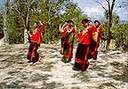
Tribal Museum : The only Tribal Cultural Museum in the Hill Tracts region was established at Rangamati town in 1978 and run by the Tribal Cultural Institute. It preserves valuable objects and articles of different tribes depicting their socio-economic, cultural and historical tradition. These include typical tribal dresses, ornaments, arms and ammunitions, coins, statues made of wood, bronze and other metals, musical instruments, ivory products, handicrafts, paintings on tribal life etc. Open: Saturday- Thursday, 10.00 a.m.- 4.00 p.m. Closed: Friday & Public Holidys. Admiddion is free.
Kaptai lake : The Kaptai lake is a wonderful spot for boating and cruising. Parjatan and private operators offer a number of cruises by mechanical boats. One can go to various scenic spots in Shuvalong, Barkal, Longadu, Mainimukh and other areas by boat from Rangamati.
SYLHET

The Sylhet valley is formed by a beautiful, winding pair of rivers named the Surma and the Kushiara both of which are fed by innumerable hill streams from the north and the south. The valley has good number of haors which are big natural depressions. During winter these haors are vast stretches of green land, but in the rainy season they turn into turbulent seas.
These haors provide a sanctuary to the millions of migratory birds who fly from Siberia across the Himalayas to avoid the severe cold there. Sylhet has also a very interesting and rich hilstory, Before the conquest by the Muslims, it was ruled by local chieftains. In 1303, the great Saint Hazrat Shah Jalal came to Sylhet from Delhi with a band of 360 disciples to preach islam and defeated the then Raja Gour Gobinda. Sylhet thus became a district of saints, shrines and daring but virile people. Its rich potentialities became easily attractive and the 18th century Englishmen made their fortune in tea plantation.
About 80 km. from Sylhet town connected by road and rail, Srimangal, which is known as the tea capital of Bangladesh, is the actual tea centre of the area. For miles and miles around, the visitor can see the tea gardens spread like a green carpet over the plain land or on the sloping hills. A visit to the tea plantation in Sylhet is a memorable experience. Sylhet, the tea granary of Bangladesh, not only has over 150 tea gardens but also proudly possesses three largest tea gardens in the world both in area and production.
The Shrine of Hazrat Shah Jalal : Among the several places of historical interest in Sylhet town is the shrine of Saint Hazrat Shah Jalal. Even today, more than six hundred years after his death, the shrine is visited by innumerable devotees of every caste and creed, who make the journey from far away places. Legend says, the great saint who came from Delhi to preach Islam and defeated the then Hindu Raja (king) Gour Gobinda, transformed the witchcraft followers of the Raja into catfishes which are still alive in the tank adjacent to the shrine Swords, the holy Quran and the robes of the holy saint are still preserved in the shrine.
Hairpur Gas Field and Other Spots : Twentytwo kilometers from Sylhet town is the Haripur Gas Field and at 35 km. point is the Jaintiapur's Rajbari.
Only 5 km. from Jaintiapur is Jaflong, a scenic spot amidst tea gardens. At about 35 km. north-west of Sylhet town, linked by rail, road and river is Chhatak, the seat of Assam Bengal Cement Factory, Chhatak is famous for orange garden.
Tamabil-Jaflong : Situated amidst splendid panorama, Tamabil is a border outpost on Sylhet-Shilong Road about 55 km. away from Sylhet town. Besides enchanting views of the area one can also have a glimpse of the waterfalls across the border from Tamabil. Jaflong is also a scenic spot nearby amidst tea gardens and rate beauty of rolling stones from hills.
Manipuri Dance : An interesting feature of Sylhet region is the aboriginal tribes such as the Tipperas, the Monipuris, Khasis and Garos who still live in their primitive ways in the hills, practising their age-old rites, rituals, customs and traditions. During festivals such as, Rash Leela (Full-moon night in February) and Doljatra, the attractive young girls dressed in colorful robes, dance with the male members of their choice & love. The Monipuris perform their famous dance, based on allegorical love themes of the ancient mythology.
Handicrafts : Sylhet is well-known for its wide variety of exquiste handicrafts. Well-known Sylhet cane products such as chair, table, tea trays, flower vases, bags and the exquisitely designed fine Sital Pati (a kind of mattress having natural cooling effect) are colorful souvenirs.
For accommodation at Sylhet town, some reasonably good hotels are available. Rest-house accommodation at Srimangal and other places are also available for tourists.
Temple of Sri Chaitannya Dev : About 500 years old famous temple of Sri Chaitanya Dev is located at Dhaka Dakhin about 45 km south-east from Sylhet town. The place is revered from being the ancestral home of the famous Vaishnava saint. Yearly fair is organised on the fullmoon day of the Bangla month Falgun. Hundreds and thousands of devotees from home and abroad attend this colorful fair.
Shahi Edgah : Three kilometers to the north-east of the circuit house, the Shahi Eidgah was built on a hill by the Mughal Emperor Aurangazeb in the 17th century. It looks like a grade fort but is actually meant for Eid congreation-the two biggest Muslim festivals
Gour Gobinda Fort : The Murarichand Government College is situated in a beautiful surrounding on a hillttop. To the north-west of the college lie the remains of King Gour Govinda's Fort.
Jaintiapur : Situated 43 km. to the north of Sylhet town, on the Sylhet- Shillong road, Jaintiapur was the capital of an ancient kingdom which included the khasi and Jaintia Hills and plains of Jainta. Interesting ruins of this forgotten period lie scattered throughout Jaintiapur. A drive to Jaintiapur is an interesting and worthwhile experience
Srimongal : Srimongal is famous for the largest tea gardens of world covered by lush green carpet. One can have a look into the spectacular tea processing at Tea Research Institute. Bangladesh produces and exports a large quantity of high quality tea every year. Most of the tea estates are in Sremongol. It is called "The land of two leaves and a bud". It is also called camellia, green carpet or Tea Mountain. There are a lot of tea estates including the largest one in the world. The terraced tea garden, pineapple, rubber and lemon plantations from a beautiful landscape. It is known as the tea capital in Bangladesh. Just offer entering into the tea estates the nice smells and green beauty will lead you many kilometers away.
Lawacherra Rain forest is one of the important & well-reserved forests in Bangladesh. Here visitor may see gibbons swimming through the trees and birds like bee-eater owls parrot. It is a good habitant of Deer, leopard, wild chicken, squirrel, and python. Don't miss it especially if you are bird watcher. The terrain is hilly and vegetation is fairly thick. Only one rare Chloroform tree of Asia is here and a prime attraction of travel
Kasia & Manipuri is two important ethnic-tribe live here. Manipuri is famous for its rich culture especially for dancing, singing. They are also famous for their traditional weaving. You can buy their handicrafts exquisitely woven woolen. Shawls, Sharee, Napkin, bed-cover and some should a bags. It is known as colorful community. Kasia tribe is famous for their betel leaf cultivation. They make their villages high on hilltop in deep forest and so far from town. It is like " a Piece of paradise". Certainly it will please you.
Pineapple cultivation in numerable rows of Pineapple cultivation covering largest area is very amazing and fascinating. Largest quantity of pineapple grown here of Bangladesh. It is also sweetest and best quality. Pineapple is really a greatest offer of summer but now it is cultivated all the year round. So, you can enjoy the juicy summer fruit in any time coming to its real field. Just after entering into pineapple plantation. It can be highlight for you in Sremongol.
Madhabkunda surrounded by lush tea estates and full of waters lilies is a unique one. Magurchara ruined gas & Oil reserved field, which was blasted while digging 3 years ago and was burning an 500-feet height for more than 3 months. A lot of burnt trees now carrying the symbols of digester. Ever where a lot of rubber & lemon plantation form a beautiful landscape. And you can have a visit to Madhobkundo water fall .
DHAKA
 Dhaka sits on the north bank of the bustling Buriganga River, roughly in the centre of the country. If you've arrived in Dhaka from South-East Asia, you'll probably be struck by the lack of hype and commercial activity. If you arrive from Delhi or Kathmandu, you're sure to notice the relatively clean air. If you've flown from Calcutta you might find it clean and orderly and if you've come overland through rural Bangladesh, it will seem like Babylon. Here the lights are as bright as they get in Bangladesh, and there's a range of goods and services lacking elsewhere in the country. The oldest section of the city runs along the north bank of the waterfront and was developed when Dhaka was a significant Moghul trading centre. A must-see in the Old City is the area between the two main water transport terminals, Sadarghat and Badam Tole where the panorama of river life on the Buriganga is particularly fascinating. This area is always crowded with people and watercraft of every type. Along the waterfront is the old baroque-style palace, Ahsan Manzil which has been painted bright pink. Dhaka is located in the geographic center of the country. It is in the great deltaic region of the Ganges and Brahmaputra rivers. The city is within the monsoon climate zone, with an annual average temperature of 25 deg C (77 deg F) and monthly means varying between 18 deg C (64 deg F) in January and 29 deg C (84 deg F) in August. Nearly 80% of the annual average rainfall of 1,854 mm (73 in) occurs between May and September. Dhaka is in one of the world's leading rice- and jute-growing regions. Its industries include textiles (jute, muslin, cotton) and food processing, especially rice milling. A variety of other consumer goods are also manufactured here. The Muslim influence is reflected in the more than 700 mosques and historic buildings found throughout the city. The University of Dhaka (1921) and several technical schools and museums are located here. GENERAL INFORMATION Area : 815.85 Sq. kilometres (approx.) Population : Seven million (approx.) Climate : Tropical, with heavy rainfall and bright sunshine in the monsoon and warm for the greater part of the year. The winter months, from November to March, are however, most likeable, cool and pleasant. Temperature: Max. Min. Summer : 36.7°C 21.1°c Winter : 31.7°C 10.5°c Rainfall : 2540 mm annually. Humidity : 80 percent (approx.) ATTRACTION OF DHAKA Mosques : Dhaka has several hundred mosques. Prominent are Baitull Mukarram-National Mosque, the seven Domed Mosque (17th century), Star Mosque (18th century) , Chawkbazar Mosque and Huseni Dalan Mosque. Hindu Temples : Dhakeshwari Temple (11th Century), Ramkrishna Mission. Churches : Armenian Church (1781 A.D.) St. Mary's Cathedral at Ramna, Church of Bangladesh or former Holy Rosary Church (1677A.D.) at Tejgaon. National Memorial : It locates at Savar, 35, km. from Dhaka city. The memorial designed by architect Moinul Hossain is dedicated to the sacred memory of the millions of unknown martyrs of the war of liberation. Lalbagh Fort : It was built in 1678 A.D. by Prince Mohammad Azam, son of Mughal emperor Aurangazeb. The fort was the scene of bloody battle during the first war of independence (1857) when 260 sepoys stationed here backed by the people revolted against British forces. Outstanding among the monuments of the Lalbagh are the tomb of Pari Bibi , Lalbagh Mosque, Audience Hall and Hammam of Nawab Shaista Khan now housing a museum. The capital city Dhaka predominantly was a city of the Mughals. In hundred years of their vigorous rule successive Governors and princely Viceroys who ruled the province, adorned it with many noble monuments in the shape of magnificent places, mosques, tombs, fortifications and 'Katras' often surrounded with beautifully laid out gardens and pavilions. Among these, few have survived the ravages of time, aggressive tropical climate of the land and vandal hands of man. But the finest specimen of this period is the Aurangabad Fort, commonly known as Lalbagh Fort, which, indeed represents the unfulfilled dream of a Mughal Prince. It occupies the south western part of the old city, overlooking the Buriganga on whose northern bank it stands as a silent sentinel of the old city. Rectangular in plan, it encloses an area of 1082' by 800' and in addition to its graceful lofty gateways on south-east and north-east corners and a subsidiary small unpretentious gateway on north, it also contians within its fortified perimeter a number of splendid monuments, surrounded by attractive garden. These are, a small 3-domed mosque, the mausoleum of Bibi Pari the reputed daughter of Nawab Shaista Khan and the Hammam and Audience Hall of the Governor. The main purpose of this fort, was to provide a defensive enclosure of the palacial edifices of the interior and as such was a type of palace-fortress rather than a seige fort. 1857 Memorial : ( Bahadur Shah Park) Built to commemorate the martyrs of the first liberation war (1857-59) against British rule. It was here that the revolting sepoys and their civil compatriots were publicly hanged. Bangabandhu Memorial Museum : The residence of the father of the nation Bangabandhu Sheikh Mujibur Rahman at Dhanmondi has been turned into a musuam. It contains rare collection of personal effects and photographs of his lifetime. Mukti Juddha Museum : Situated at Segun Bagicha area of the city the museum contains rare photographs of Liberation war and items used by the freedom fighters during the period. Ahsan Manzil Museum : On the bank of the river Buriganga in Dhaka the pink majestic Ahsan Manzil has been renovated and turned into a museum recently. It is an example of the nations rich cultural heritage. It was the home of the Nawab of Dhaka and a silent spectator to many events. The renovated Ahsan Manzil is a monument of immense historical beauty. It has 31 rooms with a huge dome atop which can be seen from miles around. It now has 23 galleries displaying portraits, furniture and household articles and utensils used by the Nawab. Curzon Hall : Beautiful architectural building named after Lord Curzon. It now houses the Science Faculty of Dhaka University. Old High Court Building : Originally built as the residence of the British Governor, it illustrates a happy blend of European and Mughal architecture. Dhaka Zoo : Popularly known as Mirpur Zoo. Colorful and attractive collections of different local and foreign species of animals and birds including the majestic Royal Bengal Tiger are available here. National Museum : Located at the central point of the city, the museum contains a large number of interesting collections including sculptures and paintings of the Hindu, Buddhist and Muslim periods. Botanical Garden : Built on an area of 205 acres of land at Mirpur and adjacent to Dhaka Zoo. One can have a look at the zoo and the botanical garden in one trip. National Park : Situated at Rejendrapur, 40 km. north of Dhaka city , this is a vast (1,600 acres) national recreational forest with facilities for picnic and rowing etc. Central Shahid Minar : Symbol of Bengali nationalism. This monument was built to commemorate the martyrs of the historic Language movement of 1952. Hundreds and thousands of people with floral wreaths and bouquet gather on 21 February every year to pay respect in a solemn atmosphere. Celebrations begin at zero hour of midnight. National Poet's Graveyard : Revolutionary poet Kazi Nazrul Islam died on the 29 August 1976 and was buried here. The graveyard is adjacent to the Dhaka University Mosque. Suhrawardy Uddyan (Garden) : A Popular Park. The oath of independence of Bangladesh was taken here and Father of the Nation Bangabandhu Sheik Mujibur Rahman gave clarion call for independence on this occasion on the 7th March 1971. The place is famous for its lush verdure and gentle breezes. Eternal Flame to enliven the memory of the martyrs of our Liberation war has been blown here recently. Mausoleum of National Leaders : Located at the southwestern corner of Suhrawardy Uddyan, it is the eternal resting place of great national leaders, Sher-e-Bangla A.K. Fazlul Haque, Hossain Shahid Suhrawardy and Khaja Nazimuddin. Banga Bhaban : The official residence of the President, located in the city . One can have an outside view of this grand palace. Baldha Garden : Unique creation of the late Narendra Narayan Roy, the landlord of Baldha. Year of establishment was 1904. Located in Wari area of Dhaka city, the garden with its rich collection of indigenous and exotic plants is one of the most exciting attraction for naturalists and tourists. Ramna Green : A vast stretch of green garden surrounded by a serpentine lake near the Sheraton Hotel. Parliament House : Jatiya Sangsad Bhaban (Parliament House) located at Sher-e-Bangla Nagar has distinctive architectural features. Designed by the famous architect Louis I. Kahn, it may be called an architectural wonder of this region. Science Museum : The museum is a modern learning center related to the latest scientific discoveries. It is situated at Agargaon. Institute of Arts and Crafts : Situated in the picturesque surroundings of Shahbagh the Institute of Arts and Crafts has a representative collection of folk-art and paintings by artists of Bangladesh. Sonargaon : About 29 km. from Dhaka. Sonargaon is one of the oldest capitals of Bangal. A Folk Arts and Crafts Museum has been established here. Other attractions in and around Dhaka include the Institute of Arts and Crafts with its representative collection of folk art and paintings, handicraft shops. Aparajeya Bangla monument, picnic spots at Chandra and Salna, industrial estates of Tongi, Narayanganj, Demara, Tejgaon, cruising by country boat in the nearby river or a visit to a village to see jute cultivation, weaving and pottery making. Last but not the least travel by a horse driven cart or rickshaw along busy Dhaka streets is a rewarding experience. About 27 km. from Dhaka, Sonargaon is one of the oldest capitals of Bengal. It was the seat of Deva Dynasty until the 13th century. From then onward till the advent of the Mughals, Sonargaon was subsidiary capital of the Sultanate of Bengal. Among the ancient monuments still intact are the Tomb of Sultan Ghiasuddin (1399-1409 A. D), the shrines of Panjpirs and Shah Abdul Alia and a beautiful mosque in Goaldi villaae. Picnic Spots : There are good picnic spots in the area around Savar and Mirzapur. Other beauty spots connected by road with Dhaka include Joydevpur, Sripur, Madhupur, Rajendrapur National Park, Chandra and Salna, all of which have rest-houses that can be used by tourists on request to the Forest Department. Bangaldesh Parjatan Corporation owns two picnic spots with Bunglows at Chandra and Salna which can also be hired by tourists. Mosque of Baba Adam : Of a slightly later date the elegant 6-domed mosque (43'x36') of Baba Adam in Rampal near Dhaka was erected by one Malik Kafur during the reign of the last llyas Shahi Sultan, Jalauddin Fateh Shah in 1483 A.D. It displays the same characterstic features of the period such as the faceted octagonal turrets at 4 corners, the curved cornice, the facade and 3 mihrabs relieved richly with beautiful terracotta floral and hanging patterns. Star Mosque : A very beautiful mosque of the city is situated at Mahuttuly on Abul Khairat Rd; just west of Armanitola Govt. High School. Architecturally faultless (Mughal style) is a five-dome mosque with hundreds of big and small twinkling stars as surface decorations. The stars have been created by setting pieces of chinaware on white cement. Seen from the front and from far it looks as if shining above the surface of the earth. The inside of it is even more beautiful that the outside, lovely mosaic floor and excellent tiles with many floral patterns set on the walls, are all in complete harmony. The sitara Masjid was built originally with three domes in early 18th century by Mirza Ghulam Pir, a highly respectable Zamindar of Dhaka. Frequently used in calendars. Entrance: through a lane named after the mosque. Baitul Mukarram Mosque : Baitul Mukarram Mosque is situated at Purana Paltan east of Bangladesh Secretariat and north of Dhaka Stadium. Largest Mosque in the city, three storied and built after the pattern of the Kaba Sharif. Very beautiful and costly decorations in the interior. Long lawn, garden and rows of fountains to the south and east. The mosque is on a very high platform. Lovely flight of stairs lead to it; from the south, east and north. On the east is a vast varanda which is also used for prayer and Eid congregation. Below in the ground floor is a shopping centre. Ahsan Manzil Museum : On the bank of river Buriganga in Dhaka the Pink majestic Ahsan Manzil has been renovated and turned into a museum recently. It is an epitome of the nation's rich cultural heritage. It is the home of Nawab of Dhaka and a silent spectator to many events. Today's renovated Ahsan Manzil a monument of immense historical beauty. It has 31 rooms with a huge dome atop which can be seen from miles around. It now has 23 galleries in 31 rooms displaying of traits, furniture and household articles and utensils used by the Nawab. Sightseeing Tours : Bangladesh Parjatan Corporation runs conducted sightseeing tours from its Tourist Information Centre at Dhaka Sheraton Hotel. The duration of the Dhaka City sightseeing tours is three hours approximately. Other tour operators…….. CLUBS : Dhaka Club, Dhaka: formed in 1851 in the name of Ramna Dhaka Club. Accom, Rest. & Bar, Swimming Pool, Indoor Games, Tennis, Squash Ph: 880-2- 8619180-4, 505800-4 Golf Club, Kurmitola : Temporary Membership for tourists available, Golf, Rest. & Bar. Ph: 880-2-605301 Australian Club : Rd. 83, Gulshan, Membership to all Australians and New Zeaianders, Swimming, Tennis, Squash, Volleybal, Ph:880-2- 603775 American Club : Gulshan, Membership open to all Americans and their families, Swimming, Tennis, Squash, Volleyball, Basketball, Rest, Ph: 880-2-8821025-27 Swedish Club : Rd. 47, Gulshan, open to all Swedesh and their guests, Swimming, Squash, Tennis, Ph: 880-2-601043. Netherlands, Recreation Cantre : Road 74, house 33, Gulshan 2, members must be Dutch, Swimming Tennis, Rest, Ph: 880-2-602039 |
Shilaidaha Kuthibari

| The renovation of Shilai-daha Kuthibari has been completed under the Department of Archaeology, Ministry of Cultural Affairs. However, Tagore devotees as well as the masses have certain questions regarding the renovation. Silaidaha Kuthibari is now a protected national monument where a Thakur Memorial Museum has been established by the government. Noble laureate poet Rabindra-nath Tagore stayed for over a decade at irregular intervals between 1891 and 1901 at Shilaidaha Kuthibari, on the south bank of river Padma in Kumarkhali Upazila, Kushtia district. Kuthibari is a picturesque three-storied, pyramid-shaped, terraced bungalow, constructed with brick, timber, corrugated tin sheets and Raniganj tiles. The bungalow is nestled within eleven acres of orchards of mango, jackfruit and others, a flower garden and two ponds. Tagore exponent Dr Sanjida Khatun, who was one of the members of a committee, which demanded for the construction of the Rabindranath Complex at Shilaidaha, is disappointed with the mismanagement of the Kuthibari. According to her, "New constructions in front of any historical sight is a disgrace. Likewise the construction of 'Alo Complex' in front of the Kuthibari, by a local high up, has demeaned the importance as well as the beauty of the building. And the Tagore bust at the entrance of the Kuthibari has no aesthetic value. It should have been done by a renowned artist. Furthermore, the complex should have proper fencing." "While renovating a historical site, one should be aware of the history. There were Mango, Jackfruit, Bakul, Chhatim trees, which had historical relevance with many of the works by Tagore. For example, Tagore wrote Bijoyini under the Bakul tree. These tress should've been replaced by trees of same species", added Sanjida. During a visit to the Kuthibari, it was noticed that people from nearby villages were using the open stage for personal purposes such as drying paddy. Moreover, through further investigation, different mismanagement and stories related to illegal activities were revealed. The compound has apparently become a hangout joint for drug abusers. More over, people flock there for picnic parties. Concerned individuals believe that as Kuthibari has no authorised officials, mismanagement in different levels is taking place. In fact, when the 'project of Tagore Complex' was underway, there was a post of a Custodian (between 1999 and 2001). After the project ended, the post was not absorbed in the revenue budget. Sources from the Department of Archaeology informed that several times the department through the Ministry of Cultural Affairs has requested Ministry of Establishment to allocate a post of a 'Custodian' for Shilaidaha Kuthibari, but it has always been ignored. Even the change of colour of Kuthibari from red to off-white has raised question amongst historians and researchers. M Shafiqul Alam, director in charge of Department of Archaeology, claimed that the colour should be 'off white' not red. To quote him, "Scrutinising the 'Black and White' photographs of that period and verifying it with other Tagore Bungalows at Shahjadpur in Pabna and Patisar in Rajshahi, World Heritage Committee, Bangladesh, has come to the conclusion that the colour of the Kuthibari should be off-white. I believe during the first renovation of the Kuthibari in Pakistani period the colour was changed to red, which continued for a long period. That's why people are under the impression that it was originally red." Sitting in Kuthibari or on a boat on Padma, Rabindranath wrote a number of masterpieces such as Sonar Tori, Chitra, Chaitali, Katha O Kahini, Ksanika, most of the poems from Naibedya and Kheya, and the songs from Gitanjali and Gitimalya. It was here, in 1912, that the poet started translating his Gitanjali into English, which earned him the Nobel Prize in 1913. Rabindranath was deeply attached to Shilaidaha and Padma, which is evident in his Chhinna Patrabali. But, at present traces of Tagore's works are hardly found at Kuthibari. Local bauls render Tagore songs in the dialect of Kushtia and in the traditional baulBhalobashar Nayane Ke Dilo Jol, Keno Tumi Etota Pashan and more are being sold. tune for the entertainment of the visitors. And at the complex along with Tagore's classics, books by mediocre writers with titles such as Even the national arrangement of Tagore's birth anniversary on Baishakh 25, has been labelled as an 'eyewash'. Sanjida Khatun complained, "I went there once to participate at the National programme and I found it to be totally politicised. Most of the discussants at the programme had no sound knowledge on Tagore or his works." Rabindranath Tagore once wrote in a letter, "The holy place of my literary pursuits during my youth and middle age was the village of Shilaidaha kissed by the waves of Padma". Shilaidaha, with memories of the poet, certainly deserves a better treatment. |
Subscribe to:
Posts (Atom)


